Skip to content
Running a business means constantly thinking about sales, customers, employees and cash flow. Tax planning can easily become something you deal with only when a deadline approaches.
But understanding the reliefs and allowances available to your business can make a meaningful difference.
The UK tax system provides a number of legitimate ways for businesses to reduce taxable profits or certain tax liabilities. The important part is understanding which ones apply to your circumstances.
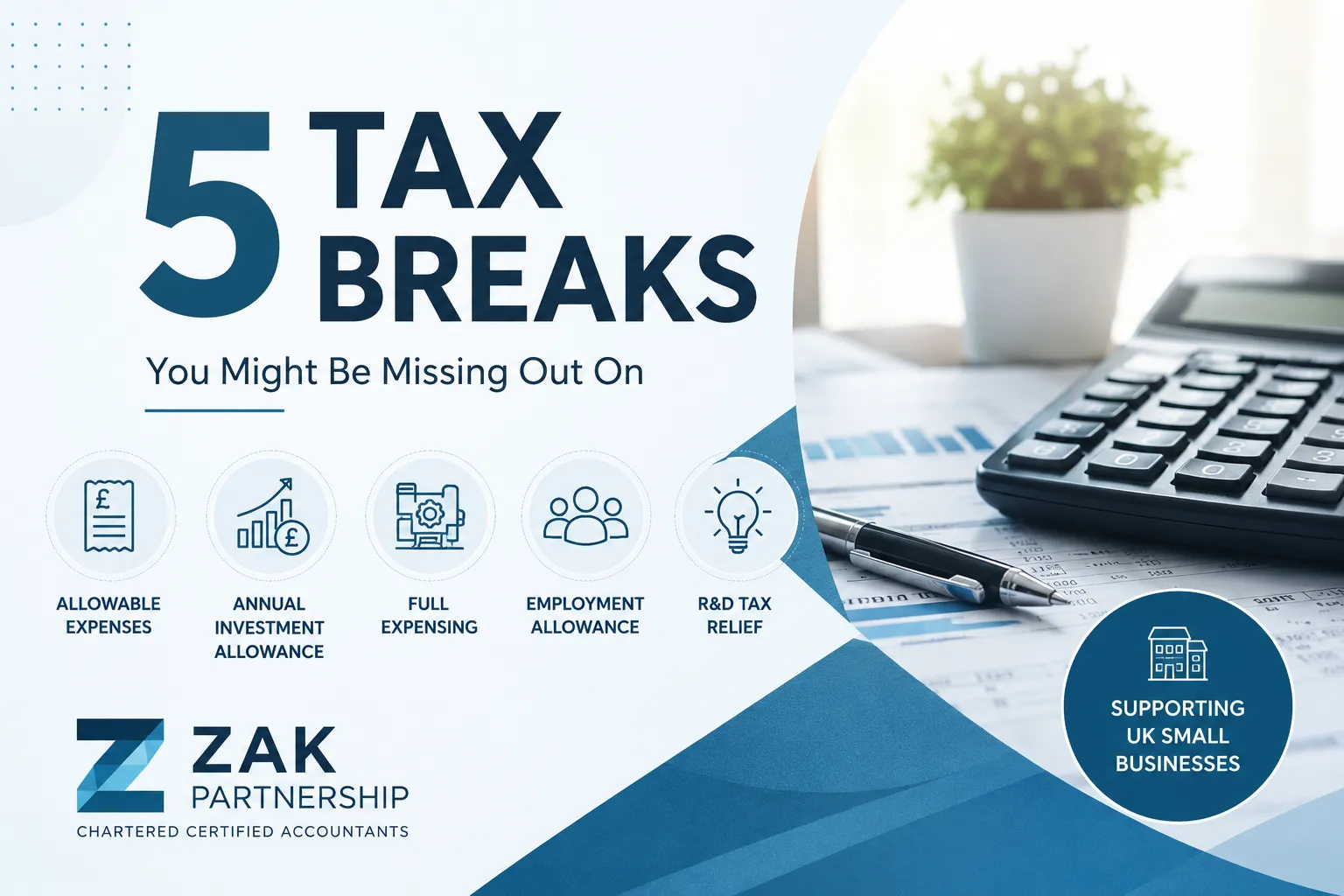
Here are five areas worth reviewing.
- Are you claiming all your allowable business expenses?
This sounds obvious, but it is one of the first areas business owners should review.
For self-employed people, HMRC lists potential allowable expenses including office costs, business travel, staff costs, stock, insurance, bank charges, premises costs, advertising, marketing and qualifying training. (GOV.UK)
There are rules and exceptions. For example, private travel cannot simply be treated as a business expense, while business-related vehicle and travel costs may qualify in certain circumstances. (GOV.UK)
Limited companies also need to distinguish between revenue and capital expenditure and ensure expenses have a business purpose. Some expenditure, such as certain client entertainment, is specifically disallowed. (GOV.UK)
Missing legitimate expenses could mean calculating tax on a higher profit than necessary.
- Annual Investment Allowance
Planning to invest in equipment for your business?
The Annual Investment Allowance (AIA) can allow a business to deduct the full value of qualifying plant and machinery from profits before tax, subject to the applicable rules.
The current annual AIA amount is £1 million. Most plant and machinery can potentially qualify, although there are exclusions, including business cars. (GOV.UK)
For a growing business investing in equipment, machinery or technology, understanding capital allowances before making major purchases can therefore be important.
- Full expensing for limited companies
Companies purchasing certain new and unused plant and machinery may also be able to benefit from full expensing.
HMRC states that full expensing allows qualifying companies to deduct 100% of eligible expenditure from profits before tax in the year of purchase. Different treatment applies to special-rate expenditure, and cars are excluded. (GOV.UK)
The timing and nature of an investment matter, so it is sensible to understand the tax treatment before committing to significant expenditure.
Disposal treatment: Where an asset on which full expensing has been claimed is later disposed of, the disposal proceeds are not simply deducted from the general pool as they would be for ordinary writing-down allowances. Instead: “there is an immediate balancing charge where the asset is disposed of. The charge is equal to 100% of the proceeds where the 100% FYA has been claimed, and to 50% of the proceeds where the 50% FYA has been claimed.
- Employment Allowance
If you employ staff, this is another area worth checking.
Eligible employers can currently reduce their employer Class 1 National Insurance liability by up to £10,500 per tax year through Employment Allowance. (GOV.UK)
Eligibility rules apply. For example, a company with only one director cannot claim if that director is the only employee liable for secondary Class 1 National Insurance. Connected companies and some other employers also have specific rules. (GOV.UK)
The allowance also needs to be claimed rather than assumed automatically. (GOV.UK)
- R&D tax relief
Research and Development tax relief is not simply about scientists working in laboratories.
Qualifying R&D expenditure can include certain staffing, software, data licence, cloud computing, consumable and contractor costs, subject to HMRC’s detailed eligibility rules. (GOV.UK)
However, R&D claims are a specialist area and businesses should not assume that ordinary product development automatically qualifies.
HMRC now operates different R&D arrangements depending on the accounting period and circumstances, including the merged scheme and Enhanced R&D Intensive Support. (GOV.UK)
This is therefore an area where professional advice can be particularly valuable.
Could your business be paying more tax than necessary?
Good tax planning is not about avoiding tax. It is about understanding the rules, maintaining accurate records and ensuring you claim the legitimate allowances and reliefs available to you.
That is also one reason why an accountant should not simply be someone who submits your accounts once a year.
The right accountant should help you understand your numbers and identify issues and opportunities before deadlines arrive.
Speak to The Zak Partnership
If you run a business in Leicester, Leicestershire or elsewhere in the UK, The Zak Partnership can review your circumstances and help you understand which expenses, allowances and tax reliefs may apply.
Book a FREE initial consultation with our Chartered Certified Accountants today.
Let us help you understand your numbers, stay compliant and make informed decisions about your business.